
Research
Browse all research publications from the DAFRC, organized by topic.
Click a category below to quickly navigate to that section.
Macro Trends | Annual DAF Reports | Donor Behavior | Management & Policy | Fundraising Strategy
-
View our research categories at a glance to quickly find the publication you’re looking for.
Financial Planning in the Age of Donor Advised Funds
The National Study on Donor Advised Funds (2024)
Donor-Advised Fund Account Patterns and Trends (2017–2020)
Analysis of Donor Advised Funds from a Community Perspective
Understanding Donor Advised Funds: How Grants Flow During Recessions
Give Me Some Slack: Donor Advised Fund Granting During Crises
Annual DAF Report 2025: Updated Analysis Memo
Annual DAF Report 2025
The National Survey of Donor Advised Fund Donors
Tubs, Tanks, and Towers: Donor Strategies for DAF Giving
Understanding the Donor-Advised Fund Giving Process: Insights from Current DAF Users
The National Survey of Donor Advised Fund Managers
Self-Regulating Donor Advised Funds: An Analysis of Inactive Account Policies and Endowed DAFs
Reinventing the Cycle: Adapting Relationship Fundraising for Donors Who Use DAFs
How Donor Advised Funds Change Fundraising
Featured Publications
-
![]()
The Annual DAF Report 2025
-
![]()
The National Study on Donor Advised Funds
-
![]()
Reinventing the Cycle: Adapting Relationship Fundraising for Donors Who Use DAFs
-
![]()
Financial Planning in the Age of Donor Advised Funds
Macro Trends
Research in this category includes comprehensive data sets and reports mapping the aggregate impact of DAFs on the modern philanthropic landscape.
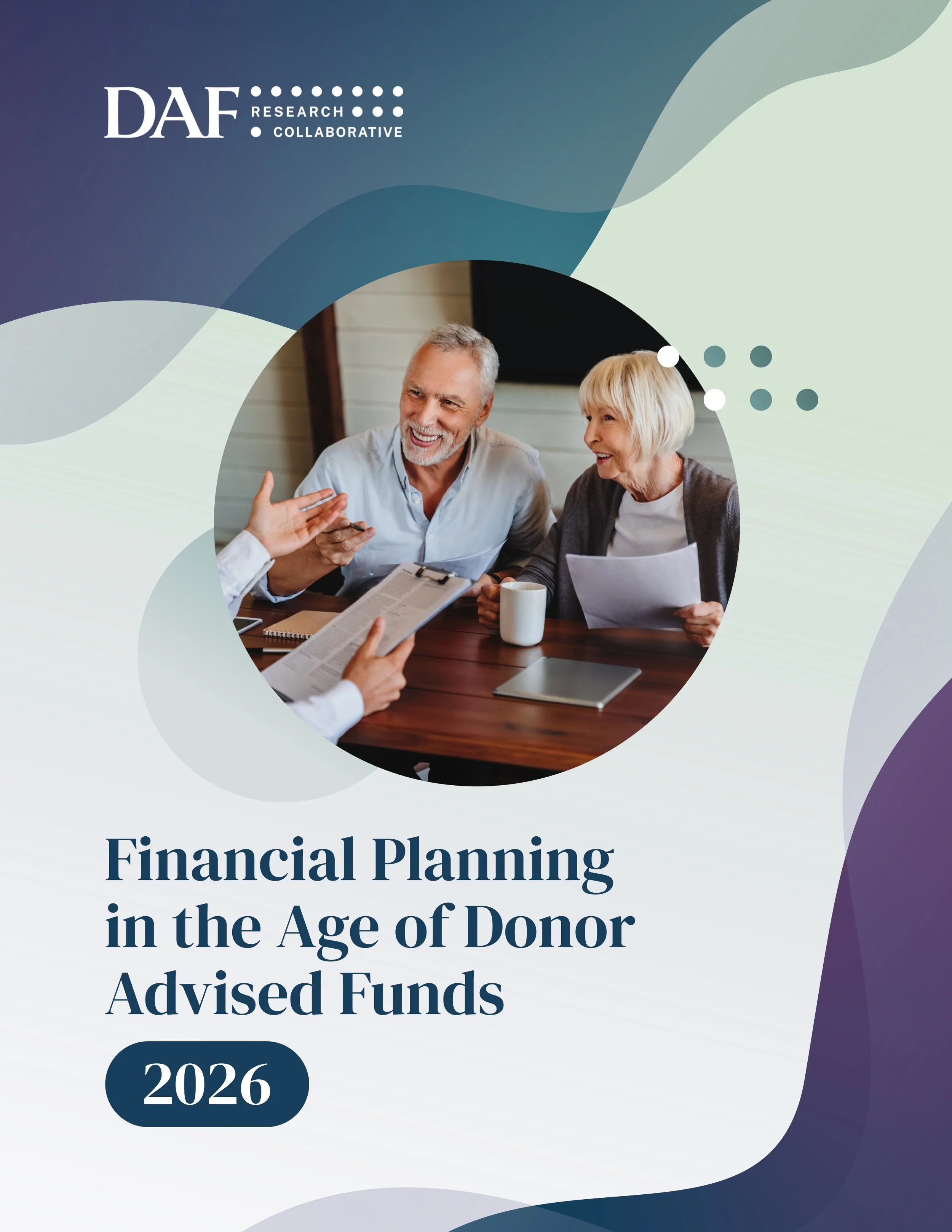
Financial Planning in the Age of Donor Advised Funds
This report draws on six focus groups and a national survey of 669 financial advisors across the country to examine how, when, and why financial advisors incorporate DAFs into charitable planning. The findings highlight current practices, motivations, and opportunities for strengthening charitable advising, especially regarding the use of DAFs.
Read more:

The National Study on Donor Advised Funds (2024)
This project includes information about DAFs from 2014 to 2022, covering aspects such as account size, age, type, succession plan, donor demographics, contributions, grants, payout rates, and grantmaking speed. The report represents the most extensive independent study on DAFs to date.
Thanks to the collective efforts of 111 DAF programs that voluntarily provided anonymized data to the research team, the data set covers nine years of activity from more than 50,000 accounts, with over 600,000 inbound contributions to DAFS and more than 2.25 million outbound grants from DAFs.
Read more:
The DAFRC research team hopes this data will be used to improve best practices, inform relevant regulation, or enhance the field’s use of DAFs as a philanthropic tool for donors, DAF sponsoring organizations, and other sector partners.
Donor-Advised Fund Account Patterns and Trends (2017–2020)
This DAFRC publication provides unique analyses of account-level data from 13,000 DAF accounts collected from DAF sponsor organizations across the United States. The report focuses on:
Differences among DAF accounts, including asset levels, accounts structure (endowed vs. non-endowed), and donor demographics;
Account-level patterns of money coming in (contributions) and money going out (grants), including payout rates and shelf-life;
Differences in giving through small, medium, and large DAFs; and,
Changes in DAF giving over time, especially during the pandemic and economic recession of 2020.
Read more:
Analysis of Donor Advised Funds from a Community Foundation Perspective

This report analyzes donor advised funds in the state of Michigan by leveraging the Johnson Center’s comprehensive database of IRS Form 990 filings for summary statistics. The team supplemented that dataset by partnering with the Council of Michigan Foundations to obtain account-level information about the more than 2,600 DAFs housed at Michigan’s community foundations. That account-level detail was used to calculate individual DAF investment returns, contribution and distribution flows, and payout rates for the years 2017–2020.
Read more:
Understanding Donor Advised Funds: How Grants Flow During Recessions
Donor advised funds (DAFs) are becoming increasingly popular in the United States. DAFs receive a growing share of all charitable donations and control a sizable proportion of grants made to other nonprofits. The growth of DAFs has generated controversy over their function as intermediary philanthropic vehicles. Using a panel data set of 996 DAF organizations from 2007 to 2016, this article provides an empirical analysis of DAF activity.
We conducted longitudinal analyses of key DAF metrics, such as grants and payout rates and found that a few large organizations heavily skew the aggregated data for a rather heterogeneous group of nonprofits. These panel data were then analyzed with macroeconomic indicators to analyze changes in DAF metrics during economic recessions. We found that, in general, DAF grantmaking is relatively resilient to recessions and payout rates increased during times of recession, as did a new variable, called the flow rate.
Read more:
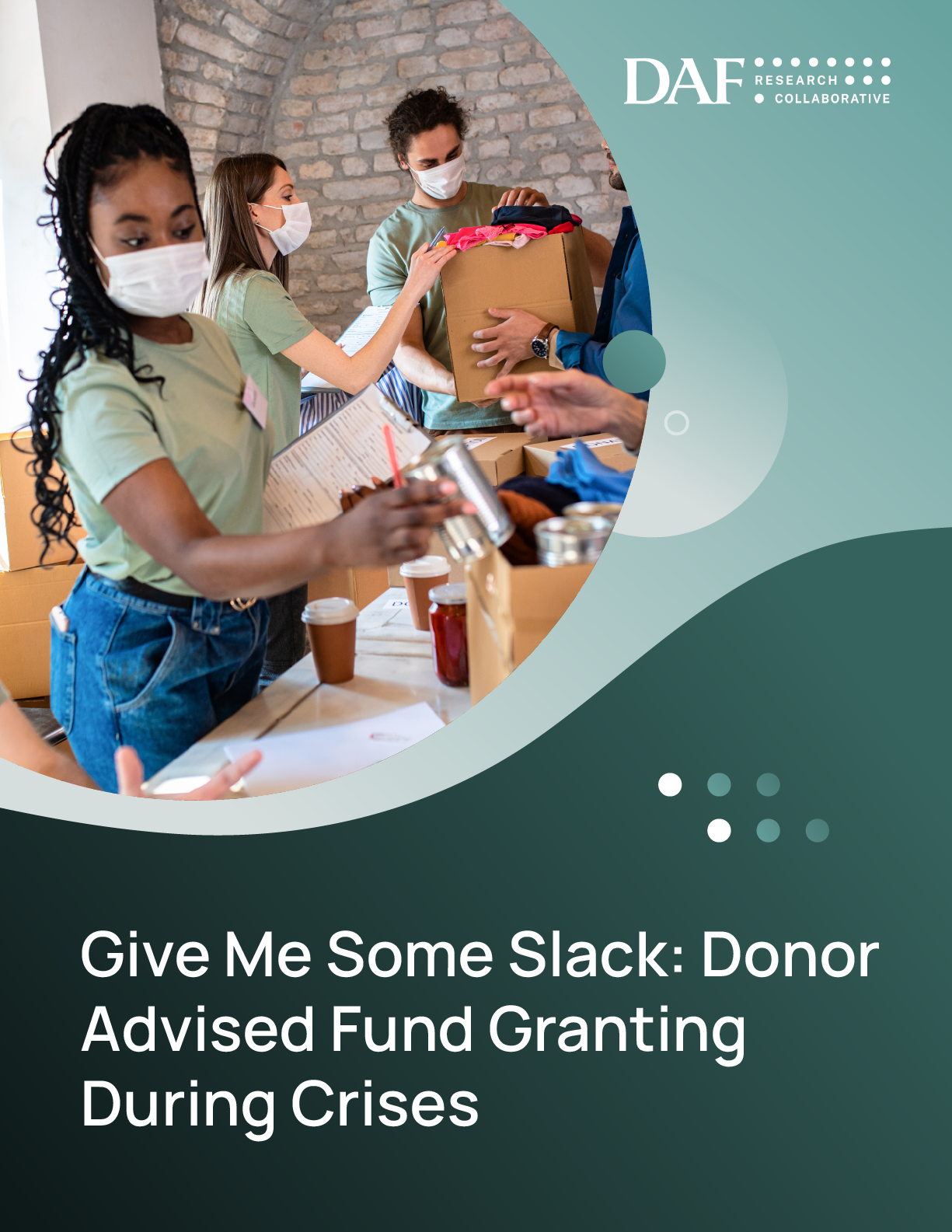
Give Me Some Slack: Donor Advised Fund Granting During Crises
In 2020, the philanthropic sector faced unprecedented demands as it responded to the global pandemic and urgent calls for racial and social justice. Early evidence indicated that US-based donors using DAFs responded to those demands by increasing grantmaking during this critical time.
This paper looks at how and why DAFs allow donors to respond to emergent needs by applying the concept of organizational slack to the DAF context. The resulting conceptual framework helps explain variation in DAF giving patterns. Findings reveal that DAF accounts that were larger, had lower payout rates, received frequent contributions, and were non-endowed gave more in 2020. Together, these findings offer valuable insights into DAF donor behavior and practical guidance for fundraisers about which donors may be most engaged during times of crisis.
Read more:
Annual DAF Reports
Research in this category includes current and past Annual DAF Reports, which draw on Internal Revenue Service (IRS) Form 990, Schedule D, data to provide comprehensive information about DAFs.
The Annual DAF Report 2025: Updated Analysis Memo
Released in the spring of 2026, this updated analysis memo contains revised results for the Annual DAF Report 2025. This update incorporates a refined list of DAF sponsors, newly released IRS Form 990 data, and limited methodological updates. These revised results were intended to replace previously reported figures to ensure stakeholders had the most up-to-date information available at the time.
Read more:
The Annual DAF Report 2025
Released in December 2025, this is the inaugural edition of the Annual DAF Report produced by the Donor Advised Fund Research Collaborative (DAFRC). For nearly two decades, the National Philanthropic Trust compiled and published data on DAFs, creating a foundational source of data for the nonprofit sector. Beginning with this 2025 edition, the DAFRC assumed independent production of the report.
This report draws on Internal Revenue Service (IRS) Form 990, Schedule D, for fiscal year (FY) 2024 to provide aggregate data on the number of DAF accounts, contributions to DAFs, grants from DAFs, DAF assets, payout rates, and average account size.
Read more:
Please see the Annual DAF Report 2025: Updated Analysis Memo for revised FY 2024 information about DAFs.
Donor Behavior
Research in this category focuses on evidence-based insights into donor archetypes, donor psychology, and the decision-making processes behind DAF-based philanthropy.

Almost 2 million people are now using donor advised funds (DAFs) for their charitable giving. To better understand how individuals think about and use DAFs as part of their household giving, the DAFRC collected data from over 2,100 DAF donors across the nation.
This report provides valuable insights on DAF donor demographics, giving strategies, and motivations, and sheds light on the patterns and variations in DAF activity observed in the National Study.
Read more:
The National Survey of Donor Advised Fund Donors
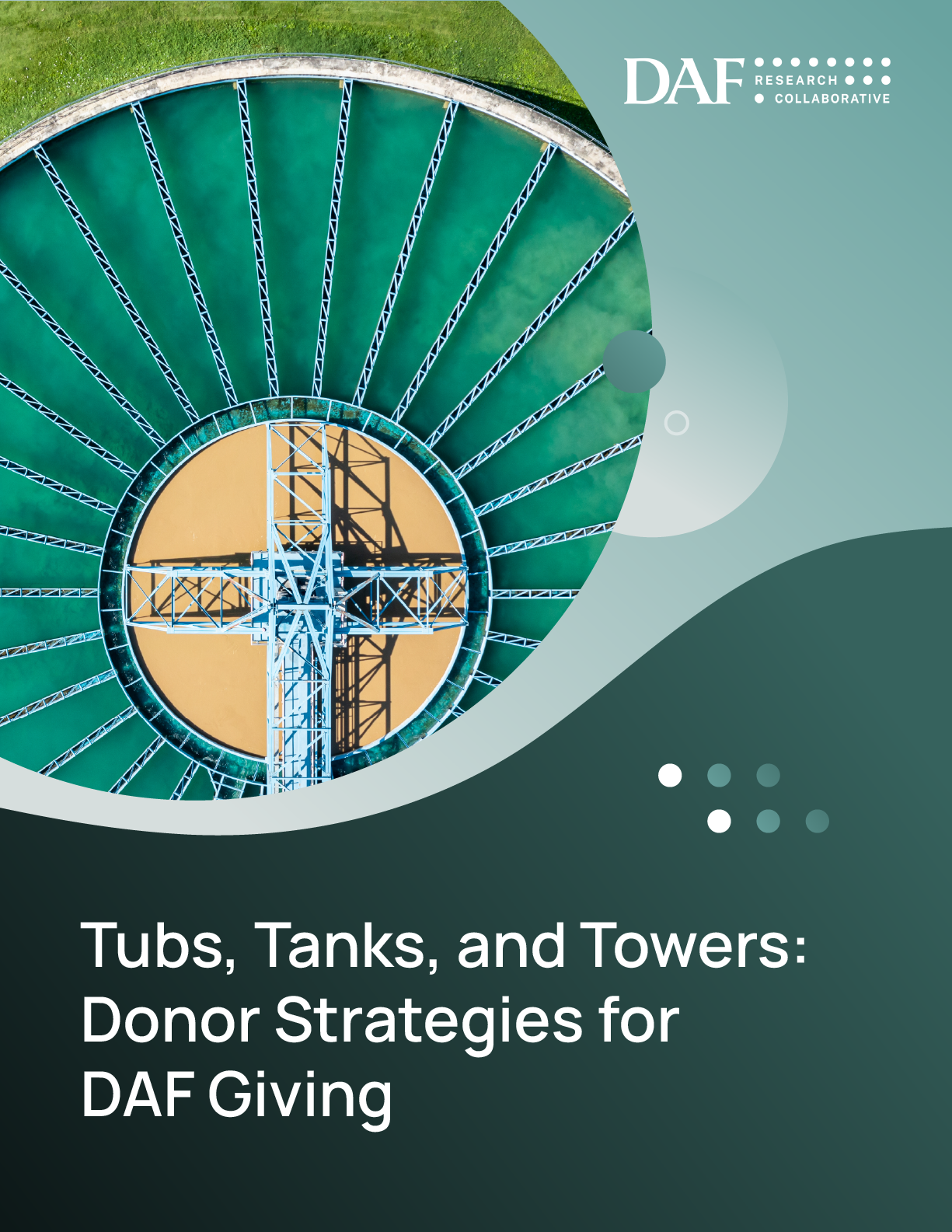
Tubs, Tanks, and Towers: Donor Strategies for DAF Giving
The increasing use of DAFs creates challenges for nonprofit managers and fundamentally changes the way that many donors give to charity. We conducted 48 in-depth interviews with DAF donors to understand their strategies of how they give through a DAF. Through the interviews, three distinct models of DAF giving strategies were found: tubs, tanks, and towers. Tub donors give quickly through a DAF, moving money in and out annually. Tank donors contribute large lump sums and grant the money away in the relatively near future. Tower donors take a calculated approach with the DAF to sustain their philanthropic activity for the long term.
Read more:
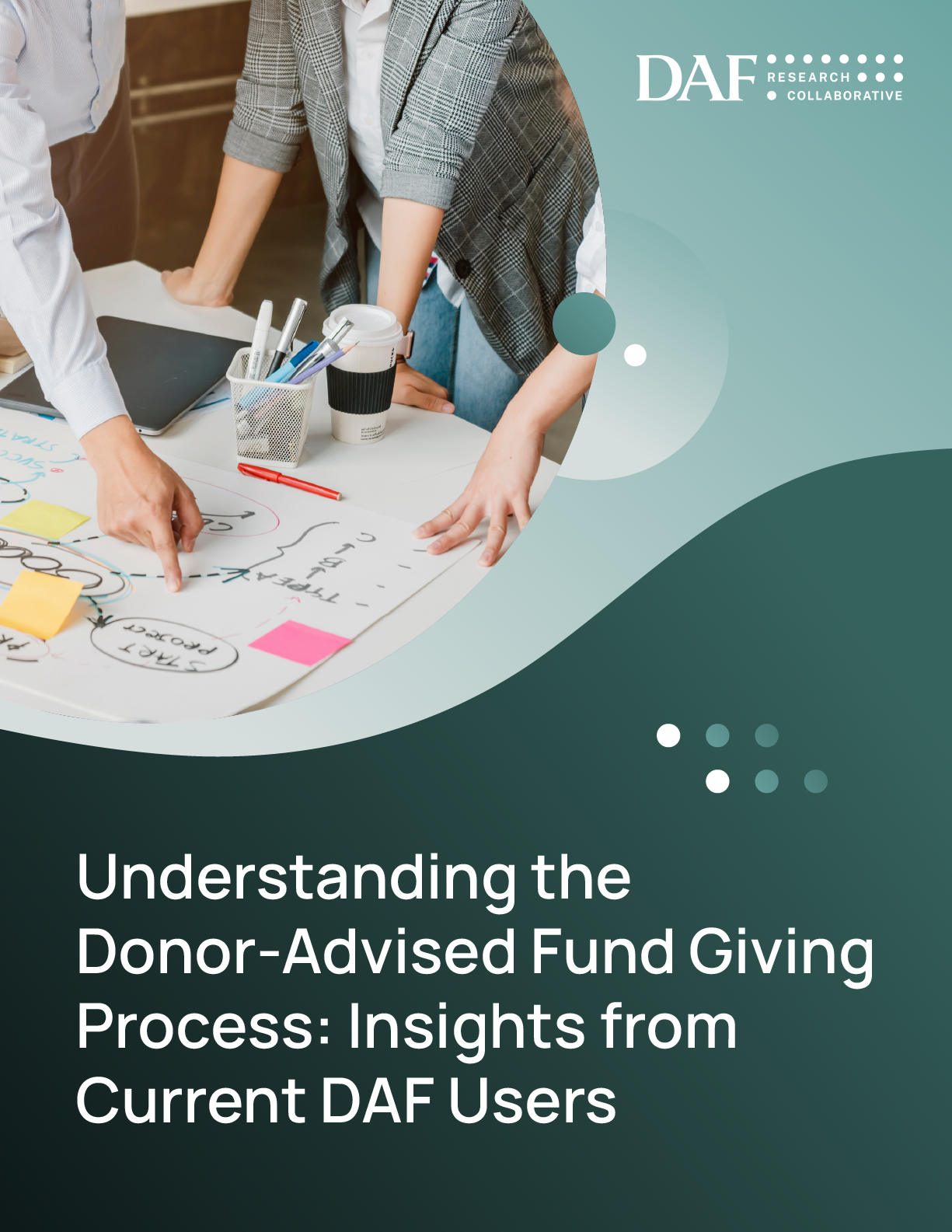
Understanding the Donor-Advised Fund Giving Process: Insights from Current DAF Users
The growing use of donor advised funds (DAFs) is changing the way many donors give to charity. Despite the increasing influence and importance of DAFs in the nonprofit sector, very little is known about how people actually use them. We conducted 48 in-depth interviews with DAF users, collecting rich qualitative data about why and how donors use donor-advised funds. We used this data to sketch a DAF giving process with four phases and multiple decision points and highlighted some of the common donor strategies that are used with DAFs. Overall, this report presents evidence of abundant diversity in individual adaptation for giving through donor advised funds.
Read more:
Management & Policy
Research in this category explores the administrative principles and institutional trends that guide the management of donor-advised fund programs.
There is considerable variation between DAF sponsors. To gain deeper insight into DAF sponsors’ perceptions, policies, and practices, the DAFRC gathered data from 128 DAF sponsor managers nationwide.
This report highlights information about DAF sponsors’ strategies, operational capacity, philanthropic advising, internal policy execution, and marketing.
Read more:
The National Survey of Donor Advised Fund Managers
Self-Regulating Donor Advised Funds: An Analysis of Inactive Account Policies and Endowed DAFs
Many are concerned about the flow of money through donor advised funds (DAFs) to other charities. Two issues that affect the flow of money from DAFs are when DAF accounts are inactive and the existence of endowed DAFs. This report analyzes internal policies from the largest DAF sponsoring organizations.
We find that the vast majority of sponsors, at least 83%, have written policies about regulating inactive accounts. We find that almost half (47%) of DAF sponsoring organizations offer an endowed DAF. Like endowments, endowed DAFs limit their annual spending to preserve the principal, and like DAFs, they allow donors privileges to advise grantmaking on the spendable funds. The internal policies on these two issues generally follow industry standards but vary somewhat in the details of how they are administered.
Read more:
Fundraising Strategy
Research in this category includes practical frameworks and research designed to help professional fundraisers adapt to the rise of DAFs and build stronger donor connections.

Reinventing the Cycle: Adapting Relationship Fundraising for Donors Who Use DAFs
This report examines how DAFs impact relationship-based fundraising. Drawing on interviews with 46 professional fundraisers, it offers practical strategies for identifying, cultivating, soliciting, and stewarding DAF donors.
The report introduces a DAF-specific fundraising cycle that outlines the key stages of DAF fundraising management and highlights both the challenges and opportunities that this intermediary presents. It also explores the roles that fundraisers play in the DAF giving process and provides actionable insights and recommendations to assist professional fundraisers in working more effectively with donors who use DAFs.
This research was funded by the AFP Wilson C. “Bill” Levis Fundraising Research Grant.
Read more:
To better understand DAFs’ implications for fundraising, the DAFRC interviewed 46 professional fundraisers familiar with DAFs across the US. The interviews focused on fundraisers’ experiences with DAF donors, their views about DAFs, and their organizations’ DAF processes.
In this paper, a new fundraising model called the “DAF Donor Relationship Management Cycle” is introduced. This model highlights six challenges and four opportunities that fundraisers face when working with DAF donors. The paper also offers valuable insights and practical advice to help fundraisers navigate the evolving DAF landscape.
Read more: